She was born in West Bengal and groomed at Santhiniketan during vibrant and turbulent times in Indian politics and culture, but Kabita Mukhopadhyay has been in Kerala for the past 21 years, as artist, art researcher and the partner of Prabhakaran, the artist who connects her to what she calls ‘the land of rich, deep and creamy palette’.
“I love Kerala and had been to the state even before I joined Prabhakaran,” she says, adding that her visit was during her Santhiniketan days. “As part of a group of students from all over the country who came to Kerala to experience the monsoon. We travelled from Tamil Nadu to Palakkad in the month of June observing the see the clouds reflecting on the hills of Sahyadri just before it starts to rain. I was fascinated by the brighter colour palette of Kerala in comparison with Bengal. Here, the red is a little more red.”
The fierceness of red and the passion of artists from Kerala later went on to influence her. She was drawn into the political, cultural, cinema and poetic awareness of Malayalis. Kabita adds, “Malayalis enjoy great respect outside Kerala for their sensitive mind, educated stance, highly committed attitude and the proportion of their way of connecting with their job, be it a clerical job, bureaucratic roles or as an artist.”
At Santhiniketan, she was influenced by Malayali poets A. Ayyappan, Ayyappa Panicker and Kadammanitta Ramakrishnan. But her greatest inspiration came from sculptor K.P. Krishnakumar, who, along with Prabhakaran and others, was the founding member of the Indian Radical Painters and Sculptors Association, the first movement of avant-garde artists in the country. The movement, which was an extension of the anti-establishment movements of the 80s, believed in making art accessible to common man, taking art to markets, schools, dhobi ghats, fishing hamlets and streets. “I haven’t seen such a true and passionate artist like Krishnakumar who works so hard, day and night. He had a very different kind of say about art, that it has to be with the masses and not in galleries. He kept questioning the Bengal romantic school which never talked about life and reality. The movement influenced and inspired many art institutions, universities, colleges, including Santhiniketan, where stalwarts like K.G. Subramanyan, another Keralite, Somnath Hore and Nandalal Bose worked,” she says.
.jpg/:/cr=t:0%25,l:0%25,w:100%25,h:100%25/rs=w:1160,h:1781)
It was at Shantiniketan that Kabita met Prabhakaran who was there for two years as part of an exchange programme from M.S. University Baroda. “He was working at my studio when I got JRF for research on the Chola art of Mahabalipuram. I wanted guidance from an authentic poetic historian and I was suggested the name of Ayyappa Panicker as the best person in and around South India to talk about Chola history.” She soon packed her bags to Thiruvananthapuram to meet Panicker. “I was so engrossed with his personality and outlook, and was drawn towards his poetic conversations about the connection between Indian languages. I couldn’t even take notes while he talked; it was such spellbinding experience listening to him.”
And then she got to know Prabhakaran more. “The radical group was dying down and he became my research material. All the artists were joining the mainstream and academic elitism, wrong ideas and gossips got spread about the radical movement. Poor Krishnakumar committed suicide in 1989. Even while everyone left the disintegrating movement, only one man stood strong on the idealistic ground – Prabhakaran. I decided to engage with his creative process to know more about him.”
Kabita says she didn’t want to take his interviews or follow him to exhibitions. Instead, she chose to be in his studio and paint his way of working. “Ultimately, we coupled to make a family and now we have four children,” she says.
Kabita’s research over the years made her explore the radical movement and ‘become a martyr’. As she puts it, “Now, I am a little aware of their way of working – their life, cultural pressure, process, suffering and depression. I went through it all and became a martyr. I won’t die again.”
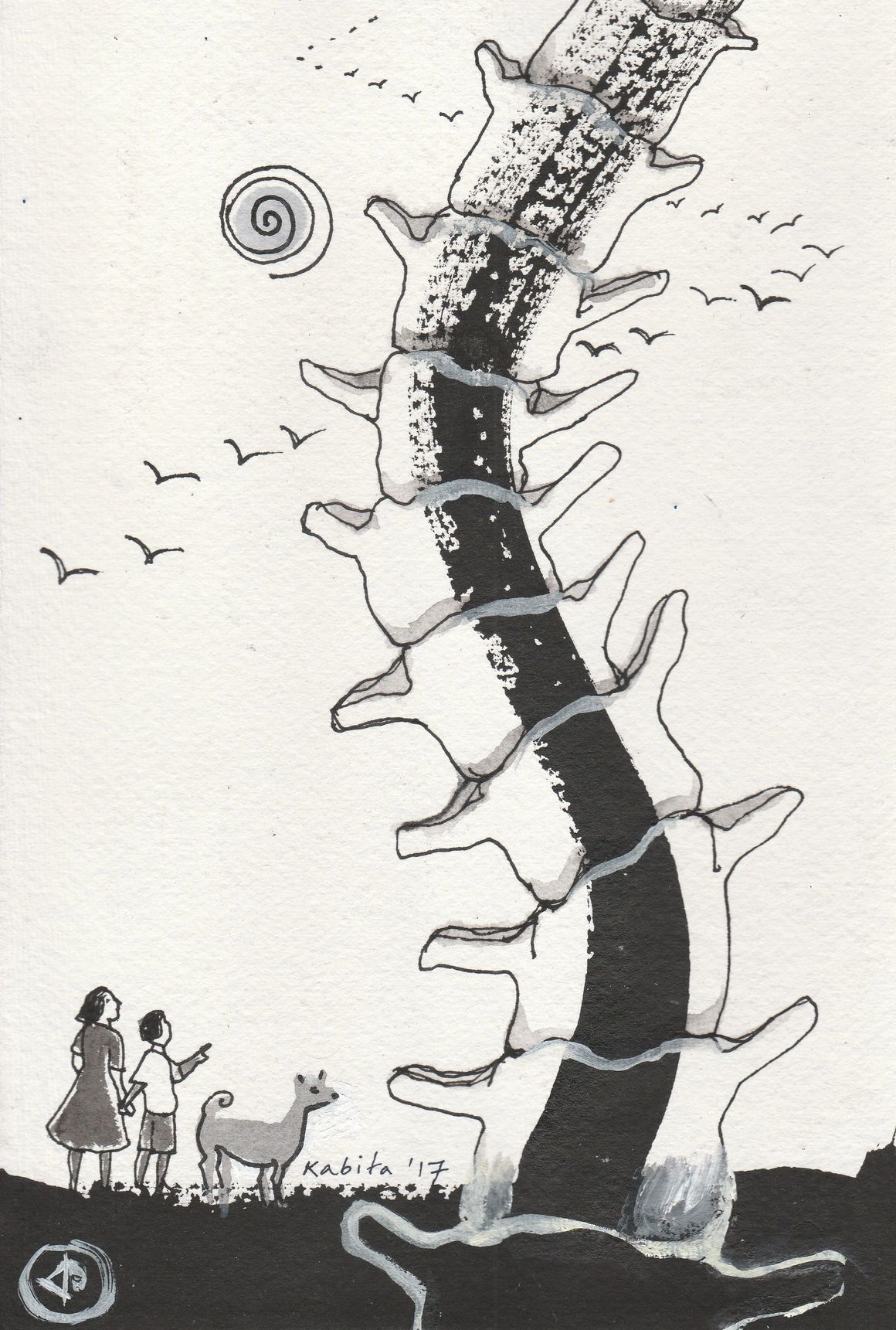
Her research is not intended for a doctoral degree, “I want this to be published. I want to distribute this understanding of mine about the radical movement in art, which is a lot more than what people had perceived.”
Kerala, for her is land of Krishnakumar and Prabhakaran, the jewels from the land who never wished to be on the stage. “Now, at 72, Prabhakaran is still strong, struggling and hanging on, staying true to his ideology and platform, with such kind of commitment the mainstream artists can’t dare to follow. A very truthful visualiser of the time, Prabhakaran’s works like Shabdikkunna Kalappa depicts the subjects which are not discussed in the mainstream,” observes Kabita, whose attachment to Kerala, therefore, is highly political too.
From time to time, she makes a visit to Bengal, to her ailing mother. As much as she adores Kerala, she feels that people have strangely become hypocrites too, “I want to understand the mystery of why people celebrate demolition of skyscrapers like an IPL match. People who ritualistically talk about Sree Narayana Guru refuse to question. My emotions are real and I know that these emotions cannot sell.” Art, for Kabita, is all about staying true and committed.
Unedited version of the feature published in the March 2022 edition of Malayalam Literary Survery


