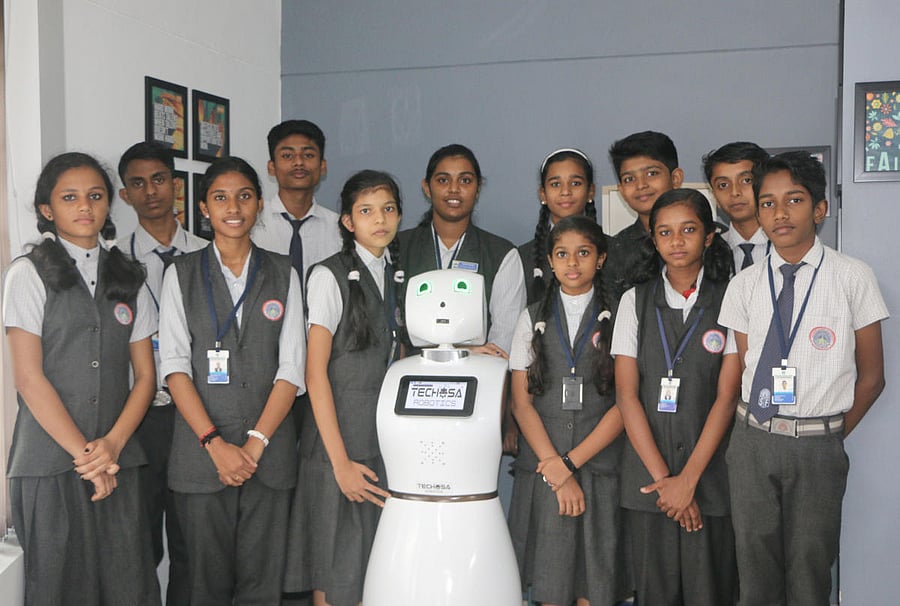
What makes Tessa, the humanoid robot, special is that the students made her from scratch and not with the help of any robotic kit
Someone who drives past Siddhartha Central School in the quiet Pallimon village at the Kollam district of Kerala would guess that something big is happening there. For the past few weeks, people from various walks of life have been thronging the school premises, with one wish – to get a glimpse of Tessa!
Well, their latest celebrity Tessa is not student, but a humanoid robot built by the Robotics Club of the school. What makes Tessa special is that the students made her from scratch and not with the help of any robotic kit. The ‘genius robot’, as the kids call it, who would sing, walk, rotate head, narrate stories, answer queries and recognize voices was born in the school robotics lab. It took almost one year for the students to develop, programme and build a working prototype of the AI-powered 27-kg robot, for which they designed the body using thermocol, plaster of paris and fibre coating.
“Around 150 students from class 7th and 8th were involved in the process. They made use of their weekly hour-long robotics period and turned up at school during weekends and holidays to work on the robot. Their enthusiasm and fascination were epidemic; the teachers too were very encouraging,” says Sam, the system administrator of the school, who guided the Robotics Club along with staff of Techosa Innovations, a robotics firm.
Tessa, built on Google Cloud database, can understand natural speech and can reply to any query. She can speak, sing and being sensor-enabled, move autonomously without hitting any object on the path. Bluetooth-controlled and enabled with gesture interaction, Tessa looks at the person who talks to her and can rotate her head to the direction of sound, reciprocating to calls and conversations.
“She is an assistant to us. She can rotate her head in 180 degrees and answer any query,” says Devananda, a seventh-grader, who is part of the robotics team, and explains the future plans, “Tessa will be our school’s main attraction. After updating her with face recognition, she will be placed at the school gate welcoming the visitors and identifying the faces of parents and guardians of the students. We are also updating her with home automation so that she can control the lights, fans and electrical system of the school, switching off anything that’s left on by mistake. As of now, Tessa has no arms, so we will first give her arms.”
The students will add surveillance mechanism to Tessa, who will also be the school receptionist who can offer the visitors a guided tour of the institution. Reciting the prayer and national anthem, she will soon grace the school assemblies and be an assistant to the sweepers by helping with cleaning.
School principal Sunitha Kumari is wowed by the students’ dedication. “They used to forgo their PT hours and holidays to work on Tessa. This was also a revelation for us that education can be fun too,” she adds.
It has been two years since robotics was added to the school curriculum with an aim to encourage lessons on technological advancement in artificial intelligence and automation. “We started with basic electronics in class V and progressed to programming concepts as the students reached class VII. We want the children to bring output through hardware. It was during a summer camp that they came up with the idea of Tessa after they were introduced to the semi-humanoid Pepper robot. Guided by their instructors, principal, parents and the management, who raised funds for the project, the students, armed by determination and passion, worked hard to make Tessa. Barring a little help with programming, everything else was done by the students themselves,” recalls Sam. The robot was built at the cost of Rs 2 lakhs.
It was proud day for the whole school when Tessa was unveiled in collaboration with the promotion of the Malayalam movie Android Kunjappan V 5.25 which narrates the story of a man who grows attached to the robot which takes care of him. Devika Praseeth, a seventh-grader from the Robotics Club remembers the day vividly, “I have never seen such a huge crowd. We were both excited and worried, but everything went well and Tessa was amazing. We are proud to be part of the glory Tessa brought to our school.”
A team of 12 students are taking the glory farther by accompanying Tessa to an international robotic conference in New Delhi. Once back to school, Tessa would be actively clearing doubts, assisting academic and manual works, doubling up as cleaning staff, guard and receptionist and above all, inspiring students to become ambitious. Ask if she would replace the teacher, Sam laughs, “No, even among robots, there’s no substitute for a teacher.” The students too would agree with him.